Last night, I came across a LinkedIn post from an aspiring programmer who was worried about his future. The same questions kept coming up in the comments: what will happen to developers? Designers? Marketing agencies? Which professions will survive AI?
That student’s concern is legitimate. What bothers me is not that he is asking those questions. It is the resignation he is too often offered in response. As though the disappearance of entire professions were already a done deal, and our only option were to watch the train pass while we wait for technology to decide our fate.
I do not believe everything is going to disappear. But I do not believe we can all keep doing exactly the same things and hope nothing changes.
Expertise needs to bring something to the table
I have enormous respect for expertise. But I refuse to confuse it with knowing how to use a tool the client does not understand, or hiding behind jargon they cannot follow. A project’s complexity is often very real; it should never become a smokescreen that keeps us from showing what we actually bring to the table.
Let’s be honest for a minute:
How many marketing agencies recycle the same campaigns, email sequences and formulas, selling each one as a custom strategy?
How many developers code a feature exactly as requested without ever asking whether it solves the client’s actual business problem?
To be clear, I am not criticizing anyone for reusing a proven architecture, a library or a good practice. Reinventing everything for every project would be absurd. A simple, familiar solution is often the best one.
The problem is not reuse. It is when we stop thinking.
It is changing the logo on a presentation’s cover and calling it strategic advice. It is delivering exactly what was on the purchase order without trying to understand what was really needed. It is treating habit as proof of excellence.
That is what I call comfortable mediocrity.
Recognizing disruption without giving in to it
And yes, I believe businesses that cling to it are going to hit a wall. Some jobs could disappear or change profoundly, and we are not helping anyone by pretending everything will be fine. Does that mean everyone who loses a job was mediocre? Absolutely not. Very capable people will be affected despite their efforts, because talent has never been a guarantee against economic upheaval.
But predicting the apocalypse of our professions gets us nowhere. I expect some businesses to close, others to adapt and new ones to emerge with something beyond yesterday’s formulas. I do not believe creativity or craftsmanship is coming to an end. What needs to end is the habit of confusing repetition with expertise, complexity with value, and meeting a specification with excellence.
A new tool. The same habits?
Artificial intelligence did not invent intellectual laziness, and it will not magically make it disappear either.
When I look at many AI-generated websites and texts today, I see the same problems as before: the same rigid structures, the same empty phrases, the same default visual choices. The tool is new, but the habit of producing without thinking has stayed the same.
Getting a first draft in ten seconds does not mean the work is done. You still need the judgement to ask whether the answer holds up, whether it addresses the need and whether it deserves to be kept.
We can use AI to churn out ten versions of a bland idea. Or we can use it to challenge that idea, explore a blind spot or build a prototype we would never have had the time or resources to try on our own. Those are very different approaches.
We have an extraordinary way to push beyond our limits. Why use it only to industrialize the ordinary? Personally, I have no interest in simply producing yesterday’s work faster. I want to see what we can build differently.
What expertise really contributes
The real value of programmers, designers and marketing professionals goes beyond writing lines of code, moving pixels or setting up ads.
A developer adds value by understanding the business logic, spotting a flaw in a process and proposing a simpler, more robust solution than the one they were asked to code.
An agency adds value by understanding what truly sets a business apart in its market, rather than selling it the latest fashionable formula.
A designer adds value by knowing why an interface choice serves the user and the message, rather than choosing it simply because it looks good on their screen.
Real creativity is not limited to art. It means connecting ideas, asking the question nobody has dared to ask, simplifying a complex problem or having the humility to admit we are heading in the wrong direction.
Giving more people room to take flight
And honestly, it is a good thing if the ability to turn ideas into reality is no longer reserved for people who already know the technical tools. An entrepreneur who cannot code being able to prototype an application, or someone with excellent ideas but difficulty writing being able to express them clearly: that is one of AI’s most promising possibilities.
Does that magically turn a rough prototype into a reliable production system? No. Technical expertise remains essential to validate, secure, architect and see a project through. But giving more people room to take flight does not take anything away from experts. It opens up new ground for them.
AI should do more than help us work faster. It should give us the means to think further.
Preparing the next generation is our responsibility too
That is also why we need to rethink how we prepare the next generation.
The fundamentals remain non-negotiable. How can we judge an answer’s quality, spot a hallucination or challenge generated code if we do not understand the underlying principles ourselves—especially when these tools can produce answers that are convincing and completely wrong?
Learning a method matters. Understanding when it applies, why it fails and how to adapt it is where the real work happens.
And that responsibility does not rest solely with CEGEPs and universities. It belongs to businesses and working professionals too, myself included. Expecting our teams to adapt while keeping them buried in timesheets, without giving them room to experiment, make mistakes and learn, is hypocrisy. That is not support.
I am not asking anyone to welcome all these changes without a trace of fear. I simply refuse to let worry become our only game plan.
This morning, at 6:57
This article began at 6:57 this morning, in my car on the way to the office. I talked it through out loud with AI through Apple CarPlay. I threw out ideas, listened to its suggestions and steered it back whenever it drifted from what I really wanted to say or smoothed over my thinking too much.
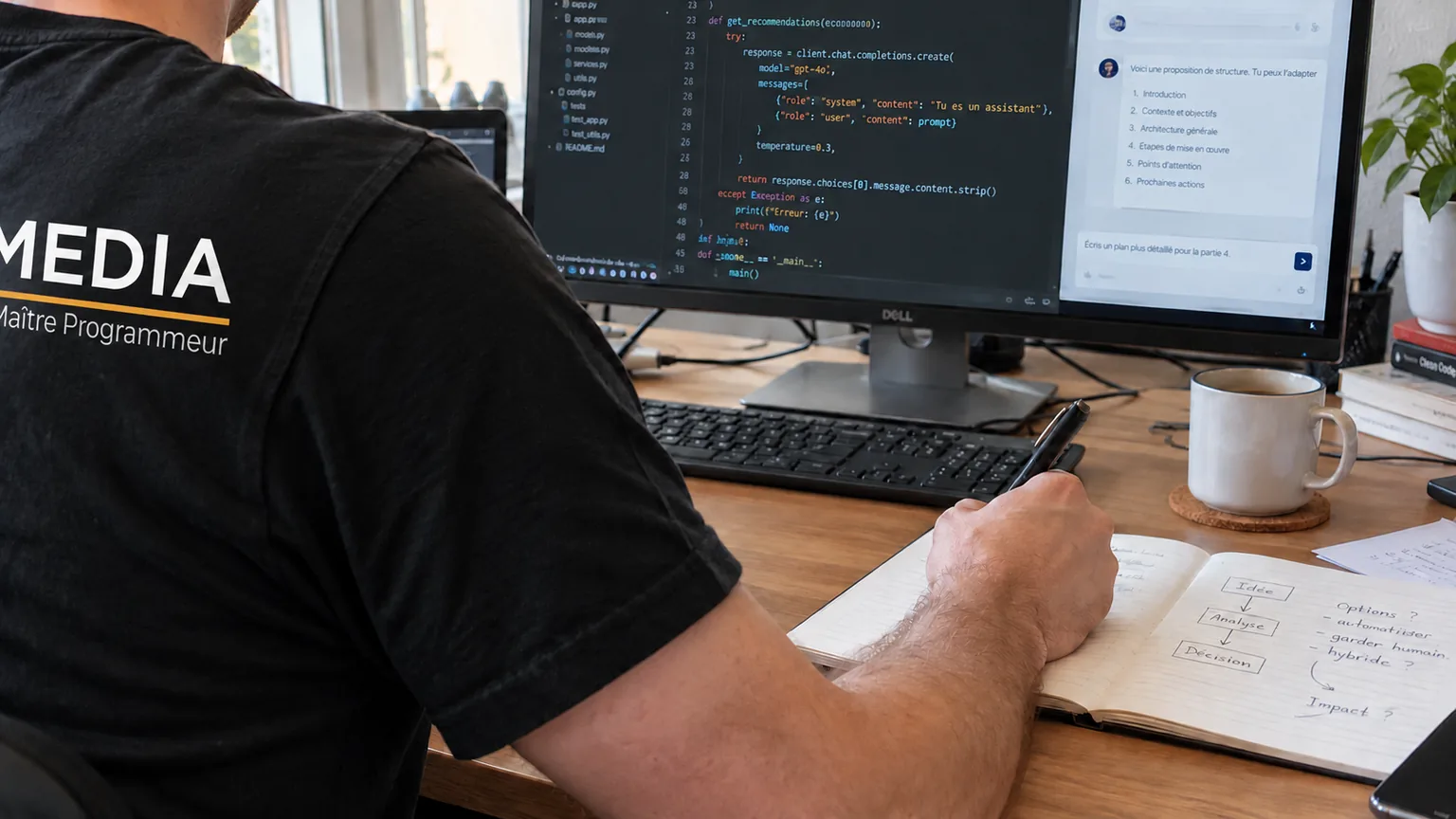
In the past, that reflection might have been lost in the day’s urgent demands. Today, I arrived at the office with a solid starting point that I could rework with other AI tools and prepare for publication directly in my code editor.
I didn’t ask AI to form my opinion for me. I asked it to help me take my own further.
About this reflection
A personal opinion by Sébastien Bernard, informed by his professional experience, experiments and conversations about artificial intelligence.
Continue the conversation with Sébastien on LinkedIn ↗AN IDEA WORTH SHARING
Keep the conversation going.